SolFi Ear Trainer
SolFi Ear Trainer (for iPhone/iPad) is an ear training application for students of music to improve their listening skills. It contains some basic exercises used by many schools to teach their students. It assumes the user has some knowledge of music theory.
It contains three exercises:
- Pitch Dictation - Given a tonic note, one or more notes are played sequentially. The user is asked to annotate the sequence using solfege or pitch names (for perfect pitch/absolute pitch). The user can choose up to four parts.
- Chord Identification - Three or more notes from a specific key are played melodically or harmonically. The user is asked to choose from a given set of chords and inversions.
- Interval Identification - Two notes are played melodically or harmonically. The user is asked to choose from a given set of intervals. This can be used to improve one’s relative pitch skills.
Pitch Dictation
This exercise will help improve your listening skills using solfege/pitch names. A melody is played and you must identify each note in the melody using the notes on top. Your answer for each note appears on the bottom. Once you finish, press Verify to validate your answer. If your answer is correct, a new melody is played. If it is incorrect, the incorrect notes will be highlighted in red and the correct answer will be shown beneath each incorrect note.

Chord Identification
This exercise will help you distinguish between different chords. Chords can be played harmonically/melodically (by changing the bpm setting) and ascending/descending. Correct answers will cause a new chord to play. For incorrect answers, the correct answer will be shown.

Interval Identification
This exercise will help you distinguish between different intervals. Intervals can be played harmonically/melodically (by changing the bpm setting) and ascending/descending. Correct answers will cause a new interval to play. For incorrect answers, the correct answer will be shown.

Keyboard
A keyboard helps with any exercise or just general practice. On iPhone, tap the piano icon at the top of the screen to open it full screen; on iPad it sits under each exercise. Use the arrows to move one key or one octave. When viewed from an exercise, the keyboard scrolls to the tonic note (or, for chords and intervals, to the lowest note played) and labels the keys with solfege, letters or intervals to match the exercise settings.
While you play, the bar above the keys names what you’re holding: a note, an interval, or a chord with its inversion. After you answer a chord or interval, playing your answer or the correct one lights its keys. You can also play the keyboard from a MIDI keyboard, connected by cable or Bluetooth (see Preferences on the main menu).

Statistics
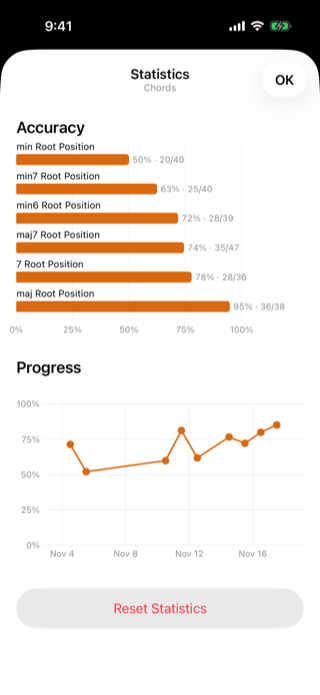
Tap the chart icon in any exercise to see how accurate you are with each note, chord or interval (weakest first) and how you’re improving day by day. Exercises also play the notes, chords and intervals you miss most a little more often.
FAQ
- Q: I don’t hear any sound from the application
- A: Turn up the volume with the volume buttons. SolFi plays even when the phone is on silent.
- Q: In Pitch Dictation, how do I choose which octaves the notes come from
- A: In the preferences, set
Lowest NoteandHighest Note. - Q: In Pitch Dictation, how can I do perfect pitch training
- A: In the preferences, set the
Note Name Typesetting to beLetter. That’s it. Optionally, you can also changeLowest Note,Highest NoteandTonic Notesettings as needed. - Q: In Chord/Interval Identification, how can I hear chords melodically
- A: In the preferences, set the
Bpmsetting to be greater than 0. - Q: How do I start my statistics over
- A: In an exercise’s statistics, tap
Reset Statistics. To clear every exercise at once, useReset All StatisticsinPreferenceson the main menu.
Contact
Email: RANDOMSTUFF -at- ACIDRAINSTORM -dot- COM